Monday, April 21, 2014

First WMSC Brown Bag a Success

By Lee Smith
Marvin Ouwinga, Karen Mills and Nancy Davis   (photo L. Smith)
An outstanding Brown Bag “course” on Islam was guided by Marvin Ouwinga on April 17. In only 90 minutes Marvin masterfully presented a Reader’s Guide version of the development of the religion, the split between Sunni and Shia, and the epitome of Islamic culture hundreds of years ago, and introduced the present-day relationship between Muslims and non-Muslims, with wide variance across the globe. The 15 participants (including some from the Norway area) were quite engaged, resulting in interesting discussion, especially regarding the potential for the future – either continued schism between the West and Islam or moderation and accommodation. The Bethel Inn had graciously opened their library, an excellent setting with good acoustics and comfortable seating. There was general agreement that the Brown Bag format was an excellent one and that there should be additional ones. Watch next fall for the second in the series, which is open to the public free of charge. If you have any ideas for topics or facilitators, you may contact Nancy Davis (nancydavis@megalink.net; 207-381-1110). We are looking for current topics or other discussion themes that may be suggested - as this one was - by a popular WMSC class.

Some of the Brown Bag attendees  (photo L. Smith)

For more information about Western Mountains Senior College visit our website at http://sad44.maineadulted.org/western_mountains_senior_college

Monday, April 14, 2014

Bladder Health and Changes: From Sneezes to Kegles

by Rosabelle Tifft

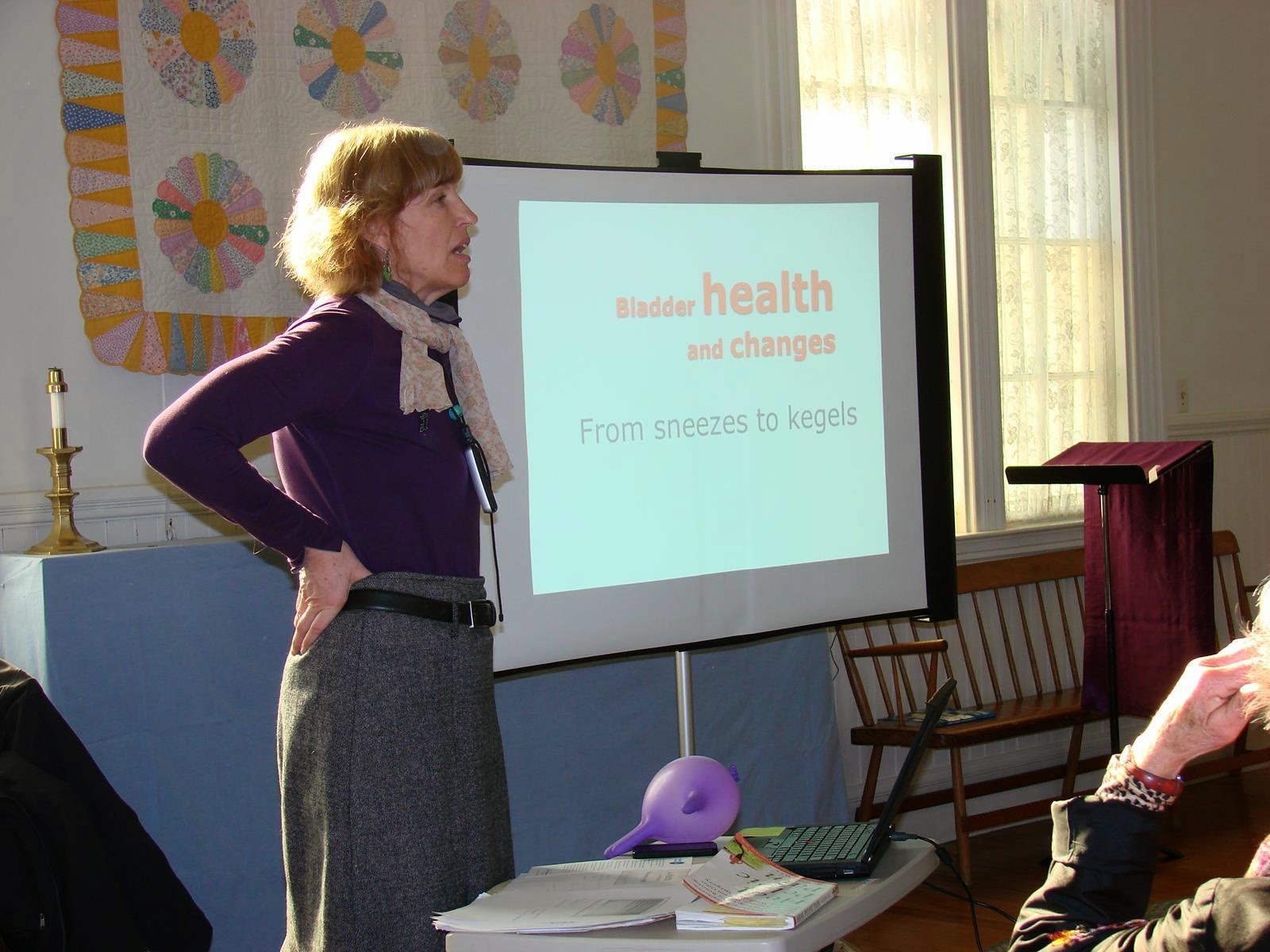
Speaker Cathy Heffernan
Cathy Heffernan, CNM, MSN, told an audience of over two dozen women at a recent To Your Health program that bladder control issues are not a normal part of aging. Cathy, a Certified Midwife with a Master’s Degree in Nursing, has over 30 years’ experience in women’s health care.

In her talk, Cathy explained what women need to know about their bladders. She discussed risk factors for incontinence or prolapse and different types of remedies that medicine might offer. She emphasized that strength is the foundation for good bladder health. Pelvic muscle exercises, known as “kegels,” are resistance exercises for preventive care or problems, and women should follow them regularly for good bladder health. Cathy explained how women can learn to do these exercises, how often they should be done, and how they can help with bladder issues. She also covered other interventions beyond kegels.

As indicated in the evaluations, the program was well received by participants who found it very interesting and educational. An up-to-date reprint covering kegel exercises was available for participants; additional copies of this handout are available in the Adult Ed Office at Telstar for interested persons unable to attend.

The program was sponsored by To Your Health of WMSC with the collaboration of Bethel Family Health Center and MSAD#44 Adult Education.


Ellen Crocker introduces TYH program
Rosabelle Tifft, Judy Whitman, Cathy Heffernan, Ellen Crocker and Jan Stowell


For more information about Western Mountains Senior College visit our website at http://sad44.maineadulted.org/western_mountains_senior_college


Monday, April 7, 2014

Mozart’s Great Mass in C

by Iris Roberts 

Although Mozart’s works are among my all-time favorites, I have never developed an interest in the history of his ouvre. However, after having attended Tom Davis’s introduction to the “Great Mass in C Minor” and then attending the live presentation of the mass at the Franco Center in Lewiston on March 30, I feel a new page turning in my own education that is most satisfying.

Tom placed Mozart in context with Bach, Handel, Haydn, and Beethoven. This overview was helpful in identifying influences on Mozart. As we listened to a recording, there they were, unmistakably: Bach, Vivaldi and Handel! Tom also helped us to understand how deeply spiritual the whole was, and how innovative using brass instruments was for a church work at that time. The very structure of the whole was an amalgam of a missa brevis and a "high mass,” with the text from the Ordinary alone but written with a grand sound intended—with double chorus, solo instruments, four soloists, and the insertion of a pastoral dance style into the Credo. Perhaps this overabundance of innovation is what caused the piece to be misunderstood in Mozart’s time and why it was never finished.

I was entranced by the recording and Tom’s presentation, and could hardly wait for the live performance! Recalling the movie Amadeus, I did wonder whether the several reverences to “too many notes” in that film would apply to this composition, performed live.

The Franco Center was more enchanting than I expected. With ascending theater seats filling what had once been a church’s nave, the whole area was filled with natural light. What a lovely, interesting performance venue for a rainy New England Sunday in early spring! At the appointed time, members of the Androscoggin Chorale filed into the former chancel to join the Maine Music Society Chamber Orchestra. As soloists took their seats, an air of anticipation filed the place, and after generous applause for sponsors, director John Corrie entered. He radiated warmth, approachable confidence, and knowledge. His remarks about the work reinforced what we had learned earlier.

The baton went up, and this wonderful director, channeling all those notes into a whole of so many harmonious complexities, gave an uplifting glimpse into one of the greatest musical minds ever. I felt that Mozart was sending his very soul to reach for something beyond himself, and this director and these musicians took the audience with them to that place. They sustained an intensity from the softest pianissimo to the most powerful forte. This shared emotional connection is what makes live performances so fulfilling. The audience’s only response: a spontaneous standing ovation to express our return gift of appreciation to the director and the performers.

How fortunate we are in Western Maine to have opportunities like this! I, and I’m sure many others, hold the deepest appreciation for so many people who, collectively, made this beautiful afternoon possible. 


For more information about Western Mountains Senior College visit our website at http://sad44.maineadulted.org/western_mountains_senior_college

Sunday, March 16, 2014

South American Adventure

by Kay Larson

Having lived and traveled internationally, I had been watching for an opportunity to explore a new area of the world when I read in the WMSC blog last fall about a group initiated within the Sunrise Senior College (Down East Maine) to tour Peru (including Macho Picchu) and Ecuador (including the Galapagos Islands) the last half of January. As I researched the details, I was attracted to the elements of learning and discovery (similar to those reported by Bonnie Marien in a recent blog about Cuba travel) by connecting with local people through guided school, home, and market visits. Unlike Bonnie, when I committed to the trip, I didn’t know any of the people I would be traveling with. No problem; with only 15 of us, we quickly became friends.

Several highlights for me are worth noting. I loved the physical and mental challenges of following the Inca Trail on a strenuous climb up to the Sun Gate at Machu Picchu, and I welcomed the flexibility that tour participants could choose alternative experiences when more appropriate to their interests and abilities. One of my favorite memories of the trip is interacting through music with the youth of a special needs school as they performed their songs and dances for and with us. In the Galapagos, our naturalist introduced us to a new world of trusting wildlife (they trusting us, and we trusting them), including taking us snorkeling with sharks (granted, not much more than a foot long).

Some tour participants have already signed up for another Overseas Adventure Travel's tour to Africa, spotlighting a safari in the Tanzanian Serengeti National Park next February. If you're interested and would like more information contact Sunrise Senior College member Etta Abrahams (etta1225@gmail.com).

Whether through Overseas Adventure Travel, who offered my trip, Road Scholar, some other travel agency, or a self-created tour, I think it would be great to make group travel a part of WMSC’s future. Please talk with me or others on the program committee if you have a vision of a great adventure, whether nearby or to distant lands.

To read more about this South American adventure in the March issue of the Maine Senior College Network Newsletter click on Sunrise and Friends' Adventure.


Experiencing Peruvian culture


The market in Urubamba, Peru - just look at that nutritious color!


Can't get enough of the awesome Incan mortarless stonework


A real "high" light: A view of Machu Picchu from the Sun Gate


Galapagos sea lions mellowing out


Older residents of the Galapagos Islands


Floral explosion on Galapagos farm

photos by Kay Larson


For more information about Western Mountains Senior College visit our website at http://sad44.maineadulted.org/western_mountains_senior_college

Monday, March 10, 2014

It's All About Color!

Cathi DiCocco with some of the colorful food we got to eat!
by Mary Haberman 

On Thursday, March 6th, Cathi DiCocco, professional chef (and Bethel treasure) showed some two dozen participants how to think about food choices, especially the nutritional values of colorful vegetables, whole grains, citrus and spices. As she talked, we watched and learned her methods of chopping, chipping, slicing, and stripping vegetables of every color that are part of her "Culinary Color Wheel."

"Pigments that give fruits and vegetables their bright color represent a variety of protective compounds for our better health," Cathi explained. For example, greens, such as spinach and kale, provide folate for healthy cells. The red of tomatoes are providing lycopene, and the yellows and oranges, vitamin C. Many of the vegetables, and some spices, are excellent antioxidants. Whole grains and beans provide essential fiber.

Cathi put together a delicious Mexican concoction (later sampled by the participants) that included everything she had talked about, plus spices for "zingers." A Waldorf salad, using roasted grapes (amazing), walnuts and local apples topped off her demonstration.

Throughout, she stressed the need to get close to what is natural - organic, unadulterated and local - when possible.

This presentation - her time, food and skills - all were Cathi's community service contribution, and we were, and are, most appreciative.


For more information about Western Mountains Senior College visit our website at http://sad44.maineadulted.org/western_mountains_senior_college

Adventures in Cuba

by Bonnie Marien

When I announced to family and friends that I was planning a trip to Cuba, a frequent response was “Why Cuba?” Other reactions included “Can people travel to Cuba from the US?,” and “Will you bring me back some cigars?” The answer to the last two questions was easy - yes to travel under certain conditions and no to cigars. The question of why Cuba is a bit more complicated.

If you are a member of Senior College, you have lived with the US government embargo of Cuba for well over 50 years. The history of the embargo is long and tortured. Most of us are familiar with at least some aspects of it. I wanted the opportunity to meet ordinary Cuban people and have access to day-to-day life on the island to judge for myself if this policy still made sense after all this time. The State Department continues to list Cuba as a terrorist nation; yet we have diplomatic relations with Viet Nam, as well as many other such nations. I wondered what special danger Cuba posed to us.

There are a number of ways US citizens can travel to Cuba. The State Department authorizes and grants licenses for travel for educational, religious, cultural, “people to people” and family reunion purposes. Road Scholar (known in the past as Elderhostel) has a license to travel to Cuba under the “people to people” category. This February my daughter and I joined one of the Road Scholar groups for nine days. 

As my daughter said at the end of our trip, “I came with no expectations and have been delightfully surprised every step of the way.” We visited schools, artists, art and music after-school programs, museums, and farmers’ markets. We had a lovely time one day at a senior club learning Cuban folk dances. A particular highlight was a leisurely visit to the Hemingway Farm, where he and his third wife lived for 30 years. The home is in perfect condition with Hemingway’s personal belongings as he left them. There are mounted animal heads, hundreds, if not thousands, of books throughout the house and beautiful pieces of art-work. At each turn the Cuban people we interacted with were open and free in inviting us to ask any questions we wanted.

Some of my impressions are that most Cubans are well educated, but there are few jobs for them once they graduate from the universities. All education is free. There is tremendous emphasis on music and art from the earliest of ages. Music is everywhere. Each neighborhood has its own medical clinic with a doctor living in the building. Medical care is free. There is now a dual system of food distribution. There are government ration stores in every neighborhood, but also many farmers’ markets, which are free market based. There are tourists (many tourists) from Canada, Europe and South America - just not from the US. Much work is going on, with the help of Brazil, China and Canada, to build a deep water port, rehabilitate Old Havana and explore for oil off the coast of Cuba. There is so much more to add but this one last thought: yes those old American cars are as fabulous as reported, particularly the convertibles.

Farmers' Market

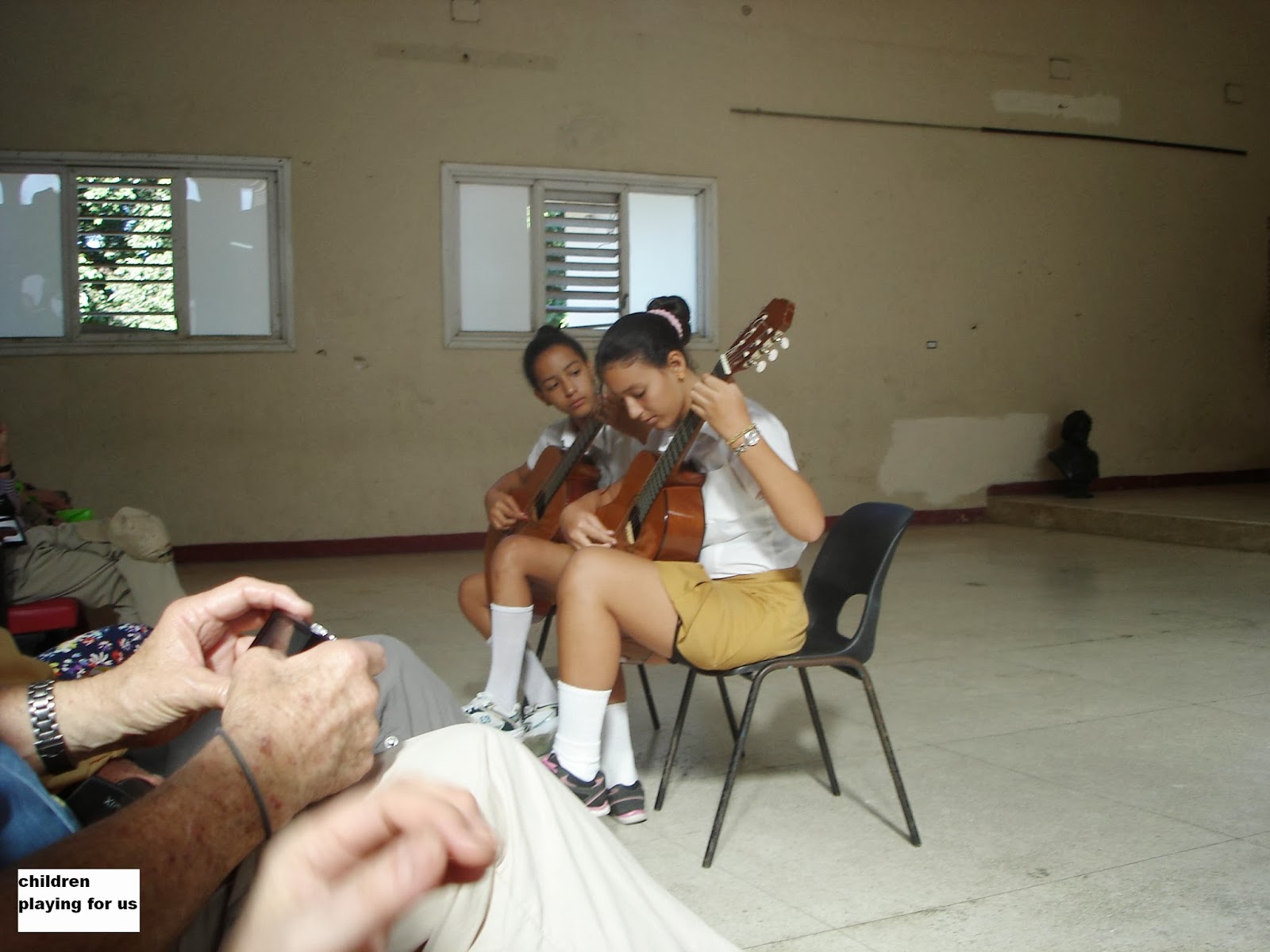
Children playing for us

Dancing at the Seniors Club

More dancing

Hemingway's typewriter
Hemingway's study

Che Memorial

One of many different types of transportation

Another popular mode of transport

Beautiful old Buick
Bonnie's favorite piece of art in one of the Old Havana squares
photos by Bonnie Marien

For more information about Western Mountains Senior College visit our website at http://sad44.maineadulted.org/western_mountains_senior_college

Sunday, March 2, 2014

Spotlight on TED Talks

by Nancy Davis

The recently-concluded "TED Talks" class had an especially engaged group of participants. Co-facilitated by Nancy Davis and Scott Hynek, the class was designed to encourage spirited discussion through the viewing of presentations from the TED Talks website.  TED Talks are described as brilliant, passionate, provocative, inspiring, original, fascinating, jaw-dropping, and paradigm-shifting.  You may watch these under-25-minute talks on your computer and may access them by presenter, topic, date, or even popularity: www.ted.com.  The presentations used in this 4-session course are listed and linked below; click on the colored text and have a look!

The topic for week 1 was the aging process.  Presentations shared during class were:
Jeremy Rifkin: The empathic civilization
Laura Carstensen: Older people are happier 
Maysoon Zayid:I got 99 problems ... palsy is just one

Related talks:
Candy Chang: Before I die I want to... 

Judy MacDonald Johnston: Prepare for a good end of life
Daniel Goleman: Why aren't we more compassionate? 
Alanna Shaikh: How I'm preparing to get Alzheimer's
Phil Hansen: Embrace the shake
Sue Austin: Deep sea diving ... in a wheelchair


The topic for week 2 was how we came to be the way we are. In-class presentations were:

Week 3 dealt with various aspects of sustainability, and the presentations were:

Pam Warhurst: How we can eat our landscapes 

Week 4's topic was various shots at philosophy.  Talks from this week were:
Damon Horowitz: Philosophy in prison

Sunday, February 23, 2014

Photos from the February 15 Snowshoe Hike

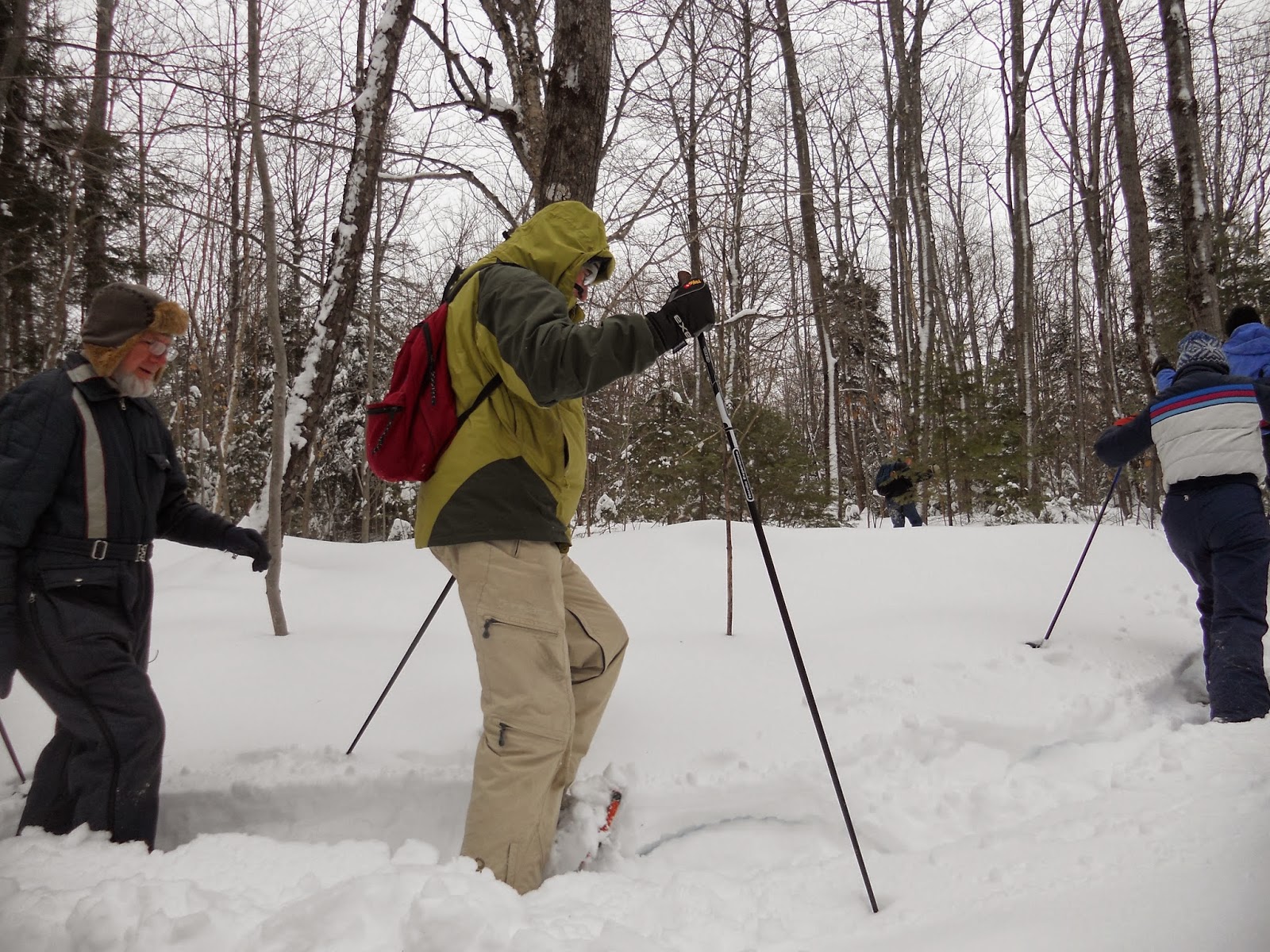
On Saturday, February 15, WMSC and the Mahoosuc Land Trust co-sponsored a snowshoe hike to Flint Farm, Bob O'Brien and Michaela Casey's farm in Albany.  We had perfect conditions, and plenty of snow! We send a special thank you to Jane Chandler for sharing her photos.


Rick Churchill, trail guide, and Bob O'Brien, our host.  photo, J. Chandler
Starting up the trail.  photo, K. DeVore
Plenty of snow!  photo, K. DeVore
Jean & Brendan Bass  photo, J. Chandler
Steve Smith and Lida Iles  photo, J. Chandler
Jim Chandler and Tim Roberts   photo, K. DeVore


Tramping a peace sign in the snow.  photo, J. Chandler
Peace sign complete!  photo, J.Chandler

Conversation and refreshments at Bob and Michaela's after the hike.  photo, J. Chandler

For more information about Western Mountains Senior College visit our website at http://sad44.maineadulted.org/western_mountains_senior_college


A Snippet From Al Cressy

It may make a difference – Last spring, before school ended, I volunteered to work for a couple of hours with a Telstar middle school teacher on an enrichment project with her class on the subject of tree rings. I enjoyed my brief time with the students, not knowing what impact, if any, I would have with these students that I had never met before. Several weeks ago when I was on my way to attend a high school assembly, one of the middle school students that I had worked with the previous year saw me in the hallway. Upon seeing me, the student said “I remember you from last June!” We exchanged greetings and then went our separate ways. After that brief exchange, I felt that perhaps I had made a difference, even though it may have been small, in this student’s academic life. This is the reason I believe it is important for adults in the SAD44 community to have encounters with the Telstar students through the Telstar High School Community Partnership Program.

For more information on the Telstar Community Partnership and how you might participate, contact Nancy Davis, 381-1110 or nancydavis@megalink.net.


For more information about Western Mountains Senior College visit our website at http://sad44.maineadulted.org/western_mountains_senior_college

Monday, February 17, 2014

To Your Health: “Fat Facts About Your Blood Chemistry and What You Can Do About It”

by Barbara Dion
 
Daniel vanBuren, MD
How much do you really know about cholesterol and the many ways it affects your body? How can you effectively lower your levels to achieve a healthier lifestyle? Dr. Daniel vanBuren answered these and many other questions at the latest To Your Health offering.

Dr. vanBuren, Director of Cardiovascular Medicine at the New England Heart Institute, presented a highly informative program, explaining how our bodies produce cholesterol and its detrimental effect on our health. He explained the differences between HDL and LDL - good versus bad. High LDL levels raise the risk of heart attacks, strokes, and other related heart problems.

There are many ways we can lower our risk factors for heart disease due to high cholesterol. Medication is often prescribed by doctors, as well as dietary changes. Avoiding foods high in saturated fat such as butter, fried foods, and cheese and replacing them with healthier choices goes a long way towards improving our levels. Exercise, smoking cessation, stress reduction, and weight control are also highly recommended.

Dr. vanBuren discussed the many different types of statin drugs that are prescribed by physicians to reduce your risk factors. He also touched on the various supplements that are often touted as helpful in reducing cholesterol and whether they are indeed effective.

All in all, the attendees left with a wealth of knowledge and maybe a little better understanding of how their bodies work. 


For more information about Western Mountains Senior College visit our website at http://sad44.maineadulted.org/western_mountains_senior_college